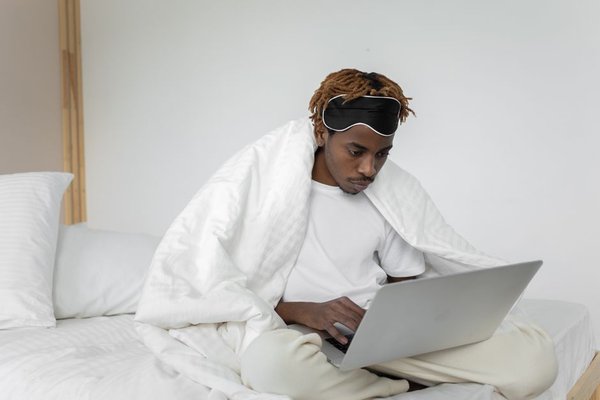
A night can look generous on the clock and still contain surprisingly little sleep. You might spend nine hours in bed but sleep for only seven, with the remaining time lost to settling down, waking up, or lying awake before morning. Sleep efficiency turns that difference into a percentage. It describes how much of your time in bed was actually spent asleep, provided you understand what the number can and cannot tell you.
What sleep efficiency measures
Sleep efficiency is the proportion of time in bed spent sleeping. A result of 90% means you slept during nine-tenths of the measured period. The remainder was wakefulness before falling asleep, during the night, or before getting up.
Unlike total sleep duration, this sleep quality metric describes the relationship between sleep opportunity and actual sleep. It can reveal wakefulness that a basic bedtime-and-wake-time record misses. It cannot tell you how restorative sleep felt, how much deep sleep occurred, or whether you slept long enough.
How to calculate sleep efficiency
The standard sleep efficiency formula is: sleep efficiency (%) = total time asleep ÷ total time in bed × 100. Use the same units for both figures. Minutes work best when your night includes short awakenings.
First, record the beginning and end of your sleep window. Estimate how long you spent asleep, subtracting time awake while trying to fall asleep, awake between sleep periods, and awake after your final awakening. Divide the sleeping minutes by the total minutes in the defined window, then multiply by 100.
A worked example
Suppose you go to bed at 11 p.m. and get up at 7 a.m., giving you 480 minutes in bed. You take 20 minutes to fall asleep, wake for 25 minutes overnight, and lie awake for five minutes before rising. Your time asleep is 430 minutes.
The calculation is 430 ÷ 480 × 100 = 89.6%. Rounded, your sleep efficiency is 90%. You spent 50 minutes awake, but the percentage alone cannot say whether seven hours and ten minutes of sleep met your needs.
Decide what counts as time in bed
Reading in bed for 45 minutes before trying to sleep can affect the result. Some trackers count the whole interval physically in bed; some sleep diaries focus on the period when you intended to sleep. Researchers have questioned these differences because they make comparisons difficult.
Record both when you got into bed and when you started trying to sleep. Whichever definition you use, apply it consistently instead of comparing percentages calculated with different boundaries.
What is a good percentage?
Sleep efficiency around 85% or higher is often used as a reference point when assessing and treating insomnia. It is not a universal pass-or-fail standard. One night at 83% does not establish a sleep disorder, just as a 95% score does not guarantee good sleep.
Picture two people. One sleeps six hours during six hours and fifteen minutes in bed, giving about 96% efficiency. Another sleeps eight hours during nine hours in bed, giving about 89%. The first has the higher percentage; the second gets two more hours of sleep. For many adults, six hours is insufficient despite the impressive score.
Read the number alongside total sleep time, daytime energy, and your usual schedule. Understanding how much sleep adults need adds useful context.
Where do the missing minutes go?
A lower percentage can describe different experiences. Long periods before falling asleep point toward sleep onset latency. Repeated overnight awakenings affect time awake after sleep onset. Waking unusually early can also leave a lengthy period in bed without sleep.
Stress, discomfort, noise, inconsistent hours, caffeine, alcohol, and health conditions may contribute. One unusual night rarely reveals the cause. Repeated difficulties, particularly when they affect daily life, deserve more attention.
Track patterns with a short sleep diary
For one or two weeks, write down bedtime, when you tried to sleep, estimated time to fall asleep, night awakenings, final waking time, and when you got up. Note naps, late caffeine, travel, or other unusual circumstances.
Calculate each night’s percentage using the same method, then look for patterns. Perhaps weekends add an hour in bed but little extra sleep. Perhaps waking periods become longer after late shifts. A sleep diary template can help you compare nights without relying on memory alone.
Your estimates will not be exact. The goal is to recognise a recurring pattern, not to treat every minute as a laboratory measurement. If detailed tracking creates anxiety, simplify it.
Can a smartwatch measure it accurately?
Watches and rings estimate sleep from signals such as movement and heart rate. They are convenient for seeing approximate trends, but they do not record brain activity as a clinical sleep study does. Quiet wakefulness can be mistaken for sleep, and accuracy varies by device and software.
If your tracker reports 92% yet you remember lying awake for a long time, treat the discrepancy as useful context. Compare several nights and your daytime functioning. Understanding sleep tracker accuracy can explain why devices disagree.
Improve your nights without gaming the score
If you regularly lie awake in bed, try a consistent wake-up time and a calm routine before sleep. Keep the room dark, quiet, and comfortable. Notice whether late caffeine or alcohol coincides with longer waking periods.
Do not raise your percentage simply by cutting sleep opportunity. A high score achieved by sleeping too little misses the point. Sleep restriction and sleep compression can form part of cognitive behavioural therapy for insomnia, but these structured treatments are best guided by a qualified clinician.
Persistent insomnia symptoms, loud snoring with breathing pauses, or significant daytime sleepiness warrant medical advice. Sleep efficiency cannot diagnose their causes.
Frequently asked questions
Is 80% sleep efficiency bad?
It means roughly one-fifth of the measured period was spent awake. If that happens often, investigate the pattern, but one 80% reading does not establish a diagnosis. Consider sleep duration and symptoms too.
Can sleep efficiency be 100%?
Theoretically, yes, if all measured time was spent asleep. Real-world estimates are less precise, and brief awakenings may go unnoticed. A tracker showing 100% is not proof of uninterrupted sleep.
Does the formula include naps?
Overnight sleep efficiency generally covers the main sleep period. Track naps separately if they matter to your routine, and avoid mixing different definitions when comparing results.
Is sleep efficiency the same as sleep quality?
No. It measures a time ratio. Sleep quality also involves sufficient duration, continuity, refreshment, and how well you function during the day.
A clue, not a verdict
Sleep efficiency answers a focused question: how much of your planned sleep window did you actually spend asleep? Calculate it consistently, examine the missing minutes, and compare the result with total sleep and how you feel. The most useful outcome is not the highest score but a clearer picture of your nights.